Solving Large Rubik's Cubes within a Factor of 2.37 + o(1) of Optimal
1MIT CSAIL, Cambridge, Massachusetts, USA · 2Technical University of Munich, Germany · 3Palo Alto, California, USA
- arXiv — soon
- Code & data
- Interactive demo
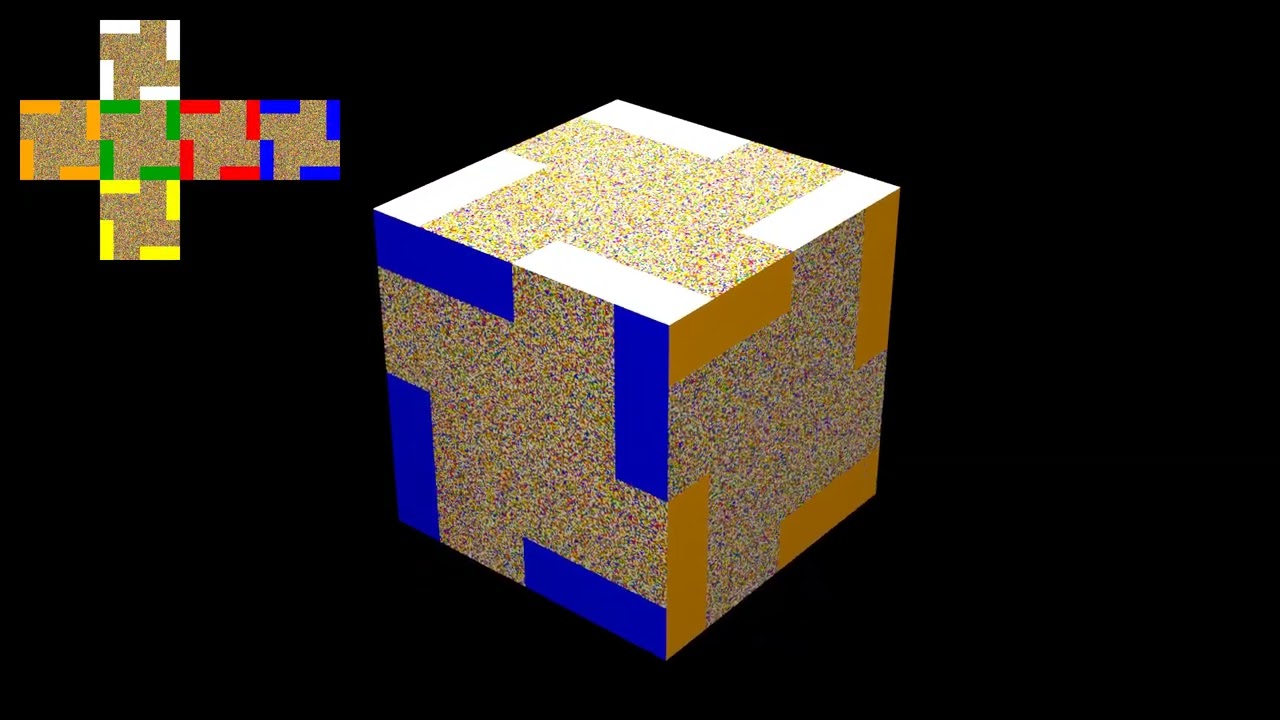
- Solve video
Abstract
We design optimized algorithms to solve the n × n × n Rubik's Cube within 30.5 n²/lg n + o(n²/lg n) moves. This upper bound is asymptotically within a factor of 2.37 of the known lower bound, which applies to almost all instances.
The constant 30.5 is also the first explicit constant factor for the known upper bound of O(n²/lg n), where the implicit constant of the previous algorithm was 2.01 · 1040 (twenty duodecillion). Thus we improve the upper-bound constant by a factor of more than 6.60 · 1038 (660 undecillion).
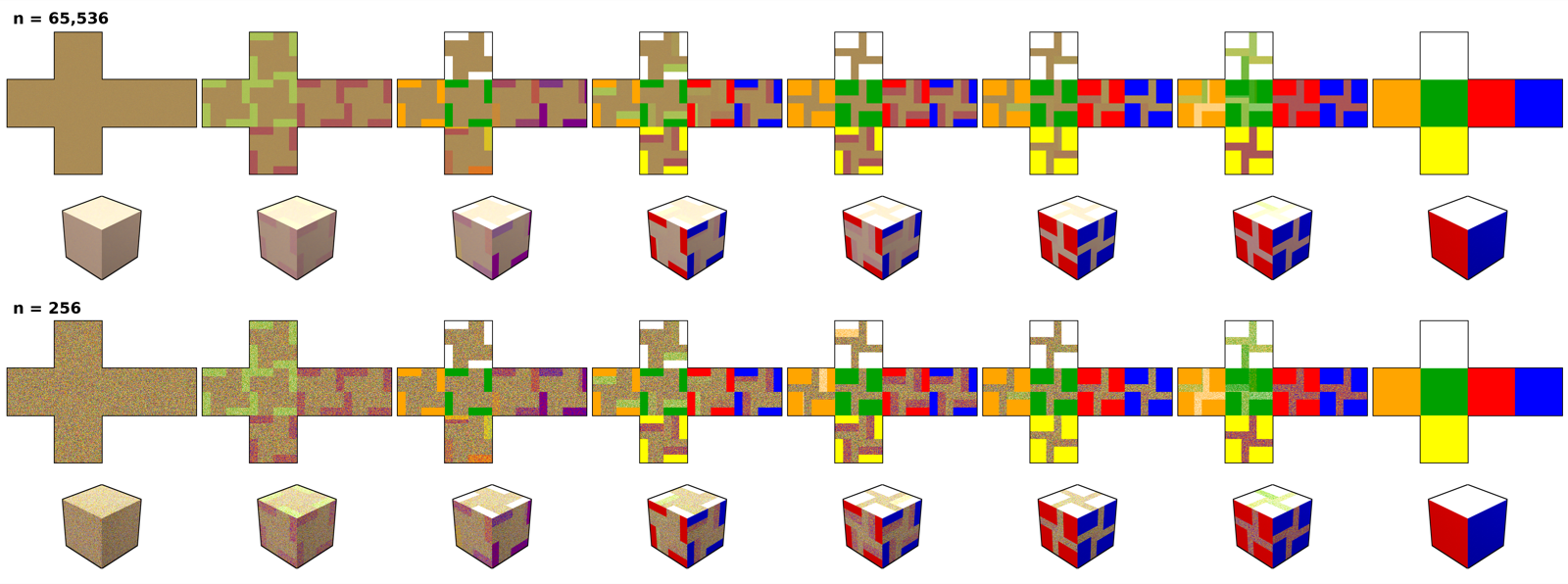
Our algorithm runs in time linear in the input size N = Θ(n²), and uses O(√ N lg N) extra space (beyond the state of the cube). Our implementation is the first practical cube solver to generate solutions of length O(n²/lg n). It outperforms existing solvers for n as small as 840.
Video
- Leading constant
- 30.5down from 2.01 · 1040
- Of optimal
- 2.37×asymptotic, worst case
- Largest solve
- 65,536cubies per edge, solved end to end